


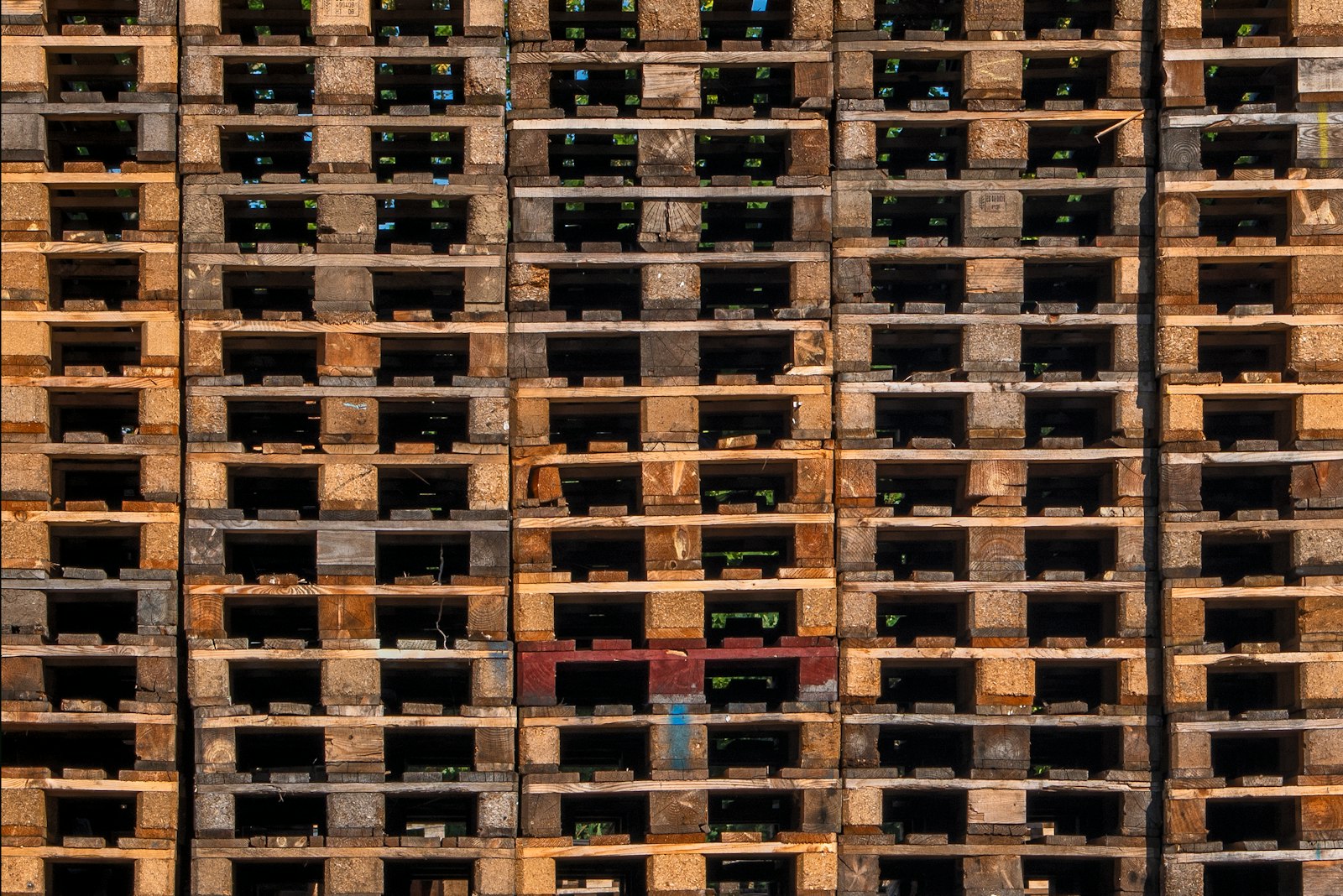
You can have every export document in order and still have your shipment stopped because of the pallets it sits on. Under ISPM 15, the international standard for wood packaging, you need a certified provider to treat and mark your timber pallets, crates and dunnage before they cross a border. If your pallets arrive without a valid mark, with too much bark or with signs of pests, the importing country decides what happens to them, and your importer receives the bill.
You can prevent most of these rejections. They usually come down to the mark on the pallet, which you can check before you pack the container.
Key takeaways:
- Importing countries can treat, destroy or send back non-compliant wood packaging, and sometimes your goods with it.
- In the US, fumigation is not accepted as a fix. The packaging or the shipment has to leave the country.
- Most rejections are for the mark: missing, incorrect or illegible.
- On Maersk’s US tariff, a container held at the port for 14 days costs USD 3,320 in demurrage alone.
- Buying from a certified supplier and checking every mark before loading prevents most problems. Plastic pallets sit outside ISPM 15.
What Happens to Non-Compliant Pallets at the Border?
Every country that applies ISPM 15 can act on wood packaging that fails inspection. What officers can order, and who pays, differs by market.
| Market | What officers can order | Who pays |
|---|---|---|
| United States | Destruction of the wood packaging or re-export of the shipment. Fumigation is not accepted as a fix. | The importer. CBP can issue a penalty for a single violation. |
| New Zealand | Treatment, pest identification, reshipping or destruction. | The importer. MPI states that “you are liable for any costs”. |
| China | Treatment or destruction under customs supervision. In serious cases, customs returns the goods with the packaging. | The owner, with fines of up to RMB 30,000 for some breaches. |
| South Korea | Destruction or return of packaging with no mark or with bark still on it. | The owner, on an officer’s order. |
| European Union | Destruction, re-dispatch or special treatment. The consignment stays under customs control until the packaging leaves. | The operator responsible for the consignment, under Article 66 of Regulation (EU) 2017/625. |
| India | Customs keeps the goods until the packaging goes through treatment at the port of entry. | Not stated. Customs releases the goods only after treatment. |
US Customs and Border Protection does not accept fumigation as a remedy and requires the importer to export the non-compliant packaging. The USDA’s Animal and Plant Health Inspection Service then traces the shipment back to you as the exporter and to your pallet supplier.
Why Do Pallets Fail Inspection?
In most cases, because of the mark. EU authorities recorded 1,248 notifications for non-compliant wood packaging in 2024, up from 1,036 in 2023. AGRINFO’s summary of the EU data shows 68% of the faults were a missing mark, 13% an incorrect mark, 12% an illegible mark, 6% an incomplete mark and 2% too much bark. In the US, a 2026 study of 7,822 interception records from 2020 to 2025 found 91% were for missing marks and 9% for pests.
APHIS lists these signs of non-compliant wood packaging:
- No mark: There is no ISPM 15 mark on the pallet.
- Illegible or incorrect mark: The inspector cannot read the mark, or it is in the wrong format.
- New and old wood mixed: A repaired pallet with replacement boards that were not treated.
- Signs of pests: Frass, exit holes or live insects.
ISPM 15 also limits how much bark can stay on treated wood, and South Korea orders packaging with bark still on it destroyed or returned.
If you ship to the US, check the hyphen as well. From 1 January 2026, US officers resumed action on marks with no hyphen after the country code, so your pallets must read “AU-” followed by the provider number.
What Does a Held Container Cost You?
Most of the cost comes from the days your container waits at the port and the work needed to release it.
- Demurrage: Maersk’s US import demurrage tariff gives four free days, then charges USD 300 a day for days 5 to 8, USD 345 for days 9 to 13 and USD 395 from day 14, for a 20ft or 40ft container. Fourteen days at the port costs USD 3,320.
- Detention: Once the container leaves the terminal, Maersk’s US detention tariff charges USD 210 to USD 290 a day after four free days.
- Inspection and treatment: New Zealand’s MPI charges NZD 155.50 an hour plus GST for a biosecurity inspector, and MPI bills treatment or disposal on top.
- Re-export: If officers send the packaging or the shipment back, you or your importer pay the freight to move it out again.
These bills go to your importer first. Your sales contract and Incoterms decide how much of the cost comes back to you. Australia’s Department of Agriculture, Fisheries and Forestry investigates notifications of non-compliance from overseas countries, and under the Australian Wood Packaging Certification Scheme a treatment provider with a major non-conformity can have its certification suspended.
How Can You Avoid It?
- Buy from a certified provider: Check the business on the AWPCS register before you order. Each certified provider has a unique number from the department, and that number appears in the mark.
- Check every pallet before loading: Look for the IPPC symbol, “AU-” with the provider number, and the treatment code (HT, MB, SF or DH). The mark needs to be clear enough to read on the dock.
- Pull repaired pallets: Replacement boards need their own treatment and mark.
- Treat the dunnage: Bracing and blocking timber in the container counts as wood packaging.
- Check the destination rules: Some countries add their own requirements to ISPM 15. Our guide on using MICoR shows where to find them.
- Switch to plastic: Plastic export pallets are outside ISPM 15, so you have no treatment to arrange and no mark to check. See do plastic pallets need ISPM 15.
How Ozkor Can Help
If you would rather not depend on a treatment provider’s stamp, we make plastic export pallets that sit outside ISPM 15. We make the Expal-1100 (1100 x 1100mm, 7.5kg) and Expal-1140 (1140 x 1140mm, 8.2kg) in Australia from recycled plastic, and the ExPod-1210 (1200 x 1000mm) nests four to one when empty.
Send us your destination, your product and the number of pallets you ship each month through our quote form, or call 1800 001 433. Our team will match a model to your market and load.
Frequently Asked Questions
Who pays if an importing country rejects my pallets?
The importing authority bills the importer for treatment, destruction or re-export, and the shipping line bills for demurrage and detention. Your sales contract and Incoterms decide how much of those costs you pay.
Will US officers accept fumigation if my pallets fail?
No. CBP does not accept fumigation as a remedy. The importer has to export the packaging, or the whole shipment.
How do I check that my pallet supplier is certified?
Search the AWPCS register for the business name or certification number. The number should match the one in the mark on your pallets.
Do I need an ISPM 15 mark on plastic pallets?
No. ISPM 15 covers wood packaging, so plastic pallets need no treatment or mark. Check MICoR for any rules your importing country adds, and we can tell you which of our pallets suits that market.